
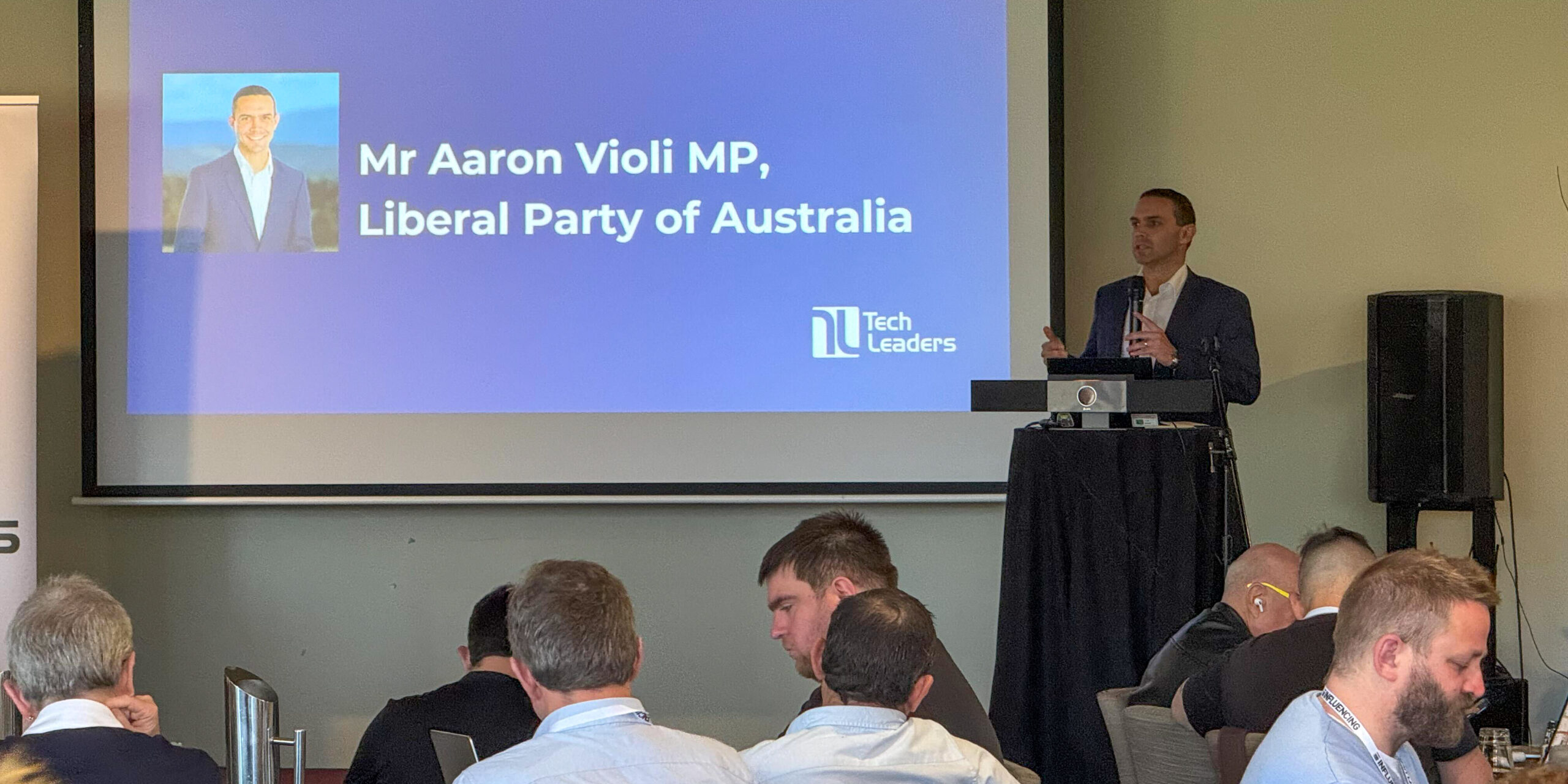
AARON VIOLI
FEDERAL MEMBER FOR CASEY
SHADOW MINISTER FOR THE DIGITAL ECONOMY
SHADOW MINISTER FOR SCIENCE, TECHNOLOGY AND INNOVATION
SHADOW MINISTER FOR CYBER SECURITY
SPEECH
TECHLEADERS SUMMIT, BOWRAL NSW
24 August 2026
CHECK AGAINST DELIVERY
Thank you for the warm welcome.
It’s an honour to join you here at Influencing’s Tech Leaders Summit.
It is fantastic to see this room full of tech leaders who are helping shape the future of tech across our nation. The journalists who tell the world about our brilliant tech sector, those who work in the tech sector, and the analysts who try to make sense of it all.
This morning I will speak about arguably the largest technological shift in a generation: artificial intelligence.
In rooms like this, artificial intelligence is praised for its speed and its groundbreaking capability. But if you step outside these doors and walk down the street in your typical suburb or regional Australian town, you hear a very different conversation. One more concerned with uncertainty and anxiety about what tomorrow brings.
In uncertain times, governments must step up and pave the way forward. Australians want to see AI that works for Australians. AI that makes their lives easier and helps them get ahead. AI that creates more jobs, more investment and more businesses.
Above all, they want to feel safe. Safe from newfound cyber threats, safe in their jobs, ensure their intellectual and creative property rights are safe.
The role of government is to give Australians the skills, tools and protections to make the most of AI.
Some day, we will look back on these crucial years as the crossroads of our future as a country.
The question is: Will we shape AI to work for Australians, or will AI shape us?
It is this direction that our nation is missing.
Australia’s AI opportunity
For decades, Australia’s economic story has been defined by what we could dig out of the ground or grow from our soil.
But today, technology presents to us an opportunity to grow a future not defined by our geography, but by our ability to adopt technology and scale it through the digital economy.
The digital sector is now Australia’s second-largest economic contributor behind mining.
The Productivity Commission has estimated that AI will benefit Australia to the tune of $116 billion over the next decade – or around $4,300 per person.
Through automating the mundane and slashing the time spent making goods or providing services, AI has the potential to bring down the costs of production across the economy.
The benefits are truly endless – optimising supply chains and predicting consumer demand will create operational savings that can be reinvested in business growth and sustainable higher wages.
As an example, AI in Medtech is optimising human health outcomes by turning health data into tools that speed up diagnoses, guide surgeries in real time and cut down on paperwork.
As one small illustration, I went to the physio recently and they’re using AI to take notes of the consultation, allowing a more detailed consultation and less administration – delivering a better outcome for patients and reduced wait times for appointments.
I passionately believe that technology and particularly AI will solve many of the economic challenges we face as a nation.
Risk: Cyber & National Security implications of AI
However, with this opportunity comes risk.
In the 2025 Annual Cyber Threat Report, the Australian Signals Directorate recorded over 84,700 cybercrime reports, averaging one report every six minutes.
Phishing, ransomware, and email compromise scams target large and small businesses, charities and individuals.
With small businesses under cost pressures, they turn their mind to reducing or ending their costs. We must make sure that cyber security isn’t seen as a cost, but as a critical part of doing business in Australia to protect us all as consumers.
Government must lean into supporting small business with their cyber security uptake.
AI brings new and bold risks. We now face cyber risk that we have never seen before.
The firing gun on the race for cyber capability sounded years ago. The most capable AI wins.
The main race is still underway between the US and China, which presents real geopolitical uncertainty and national security implications of its own.
A secondary race for capability is being run between five main competitors – Anthropic. Meta. Google. OpenAI and SpacexAI.
When the US administration issued an unprecedented order to keep Anthropic’s Fable 5 out of the hands of foreign nationals citing cyber security concerns, this was an insight into the cyber risks that lie ahead.
AI will arm both the attacker and the defender.
Anton van den Hengel, chair of the Kingston Group of Australian AI professors and chief scientist at the Australian Institute of Machine Learning, has said:
“Fable 5 made it perfectly clear that having second-rate AI will mean coming second in a conflict. Cybersecurity is an AI arms race and whoever has the best AI wins. Australia, unfortunately, isn’t even in the race.”
That is why we must on-shore capability, through the partnerships we already have with the US and our allies, while also building new ones.
The strategic importance of Pillar II of AUKUS cannot be underestimated. AI enabled drones and algorithms have changed modern conflict. Yet, as the Australian Industry Group has cited, some segments of industry are sceptical about Pillar II because funding and commercial opportunities have been slow to emerge. The Albanese Government has been slow to close the gap between its rhetoric on AUKUS and the funding needed. This is having impacts on the defence applications of AI as well.
This is just one example of why the Coalition has committed to increase defence spending to 3% of GDP.
For AI to truly succeed, it cannot remain the isolated success story of a handful of overseas tech companies.
Australia’s AI success will lie in how we choose to shape this shift for our nation.
It isn’t about building the world’s frontier models.
It’s about developing sovereign AI applications that solve uniquely Australian challenges, which can only be done thorough uniquely Australian data sets.
And as the race continues, we should stand with democracies, led by the United States, to ensure AI reflects our values, not those of authoritarian states.
It’s about bringing those models here, under our laws and our principles, and adopting AI in a way that fixes our economy while protecting our way of life.
Lack of direction on AI from Albanese Government
To date, the government’s work in this space has been underwhelming.
OpenAI’s ChatGPT burst into our lives in late 2022.
In February of 2023, I became the first Australian MP to deliver a speech in Parliament partially written by AI and own it.
I knew this technology was here to stay. With its arrival came so many questions that needed answering.
Our ability to trust what we hear and believe what we see had been diminished, and how we as a nation would grapple with the consequences of AI deserved the immediate attention of Parliament.
But that was three and a half years ago.
And as I stand here today, Australians still don’t have a vision of how AI will benefit our nation, or how we will be kept safe from new cyber risk.
It may be because the Prime Minister, in his own words, hasn’t used any AI tool.
I worked in tech before politics.
In tech, if you don’t use the product yourself, you can’t understand the user experience.
If you don’t test the system, you can’t lead the strategy or develop the vision needed.
The Prime Minister has never taken 15 minutes to download an AI tool like Claude or ChatGPT, never run a prompt, tested a new workflow or engaged with the technology he is seeking to shape.
That is a profound failure of leadership on the most important technological development in a generation.
Perhaps it explains why, over the past four years, the Albanese Labor Government have failed to outline a plan for AI adoption in our country.
They have begun multiple journeys down different roads, only to turn back and go the other way without ever reaching a destination.
They first opted for an AI Act and heavy-handed regulation. That Minister was dumped, and the government reversed course under a new Minister who was in favour of a ‘light touch model’.
So when the Prime Minister finally stood up in Sydney a month ago to deliver his grand address “AI in Australia’s Interest”, Australians tuned in to hear a vision.
Businesses, particularly the tech sector, expected a forward-looking roadmap and the clear rules of engagement they have been waiting on for years.
Instead, the government announced an office within an office, called the “Office of AI”, alongside a new set of regulations for data centres.
We absolutely need a plan for data centres to ensure they work for our communities. But a set of rules for data centres isn’t a substitute for a national plan for AI.
Frankly, it is concerning that the government have conflated the two.
Of equal concern is how the Prime Minister only mentioned the word cybersecurity once during his speech.
The line was: “We can lead in everything from cybersecurity and biotechnology to advanced manufacturing.”
It’s ironic really. We cannot lead without a plan and investment in a stronger offensive cyber capability that strikes at the actors who target Australians.
In the most dangerous strategic environment since the Second World War, Labor has left us with dangerous gaps in our defence and cyber capabilities.
What has become clear is this government doesn’t get it.
Coalition’s plan:
The Coalition and I want to see AI that works for Australians and Australia.
AI that plays a role in fixing our economy, without compromising on our way of life. AI that means more Australian jobs, more Australian investment, stronger national security and higher living standards.
That’s why last week we lead a push to establish a Joint Select Committee on Artificial Intelligence.
We cannot delay any longer.
This committee will explore the vast opportunities for Australia to grow our economy and improve the standard of living for all Australians.
It will explore the opportunities from our suburbs to the regions.
It will look at how AI can be used to drive R&D and innovation in our nation.
It will look at how we can use AI to put Australians first and protect our national interest.
And importantly, it will address the risks.
This committee will examine the workforce and skills implications of AI, job displacement but also job creation, the adequacy of Australia’s education system and the risks and harms arising from AI, particularly to the safety and wellbeing of children and vulnerable Australians.
Crucially, this Committee will also examine the cyber security and foreign interference risks.
I said in my first speech to Parliament that when making decisions on fast-moving technology we must remain agile and flexible. Traditional government decision-making cannot keep pace with AI.
A key feature of this Committee is that it will report within a short time frame and remain reactive to the speed of change.
Acting on AI isn’t a task for the future. It’s a task for now.
We don’t have time for delayed direction from a bureaucratic office within an office.
In the time I’ve delivered this speech, tech continues to evolve and the race for AI capability has continued. It will continue to move at pace during this term of Parliament and shape the next election. We must urgently create a regulatory and policy environment that allows our nation to maximise the benefits while protecting us from the risks.
Remaining cautious and waiting to see what other countries do will leave Australia a rule-taker rather than a rule-maker when it comes to rules and regulations, including military applications.
But just like our adversaries can utilise AI against us, we can choose to harness AI to strengthen our national security and protect our way of life.
Australia is at a pivotal moment.
It is incumbent on our nations leaders to ensure we urgently forge a pathway that is in our national interest, protects Australians and unlocks economic prosperity for generations to come.
Thank you.
